


Our bodies send clear signals telling us when to eat and when to stop—but are we listening?
Your body sends clear and unmistakable signals when it needs attention.
You know what it means when your mouth is dry, your eyelids are heavy or your bladder is full. And while you might be able to ignore those signals for a little while, sooner or later you’ll be driven to drink something, get some sleep, or make a trip to the restroom. 
Learning to recognize your body’s natural signals of hunger and satisfaction—and responding appropriately—are skills worth practicing.
- Growling stomach
- Headache or lightheadedness
- Shakiness
- Clouded thinking
- Fatigue
How can you get back in touch with your hunger signals?

Try to stop eating before you get too full. Too full is uncomfortable. It means you ate too much.
Get in touch with what “satisfied,” or “pleasantly full,” feels like for you.
Use a hunger scale
A hunger scale can help you learn how to tell the difference between true, physical hunger and hunger that’s really just in your head. Psychological hunger is a desire to eat that is caused by emotions, like stress, boredom, sadness, or happiness. 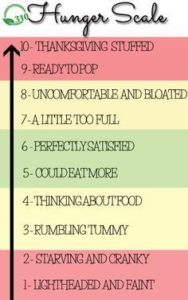
When it’s time to eat, make healthy choices
For your body to be truly satisfied, your meals need to be balanced. This means that each meal should contain:
- Carbohydrate.
- Protein.
- Fat.
Don’t deny yourself
Lots of people think that healthy eating means never having dessert or french fries or any of the things they love to eat. That’s wrong.
Your appetite, which can include a desire for sweets or other less-than-healthy treats, is a strong body signal. And part of keeping your body at that “satisfied” level on the hunger scale is eating tastes that you like and want.
A few more tips
- Try not to let your hunger drop to a 1 or 2 on the hunger scale. When you get that hungry, you’re likely to eat faster, make poorer food choices, and keep eating past the “satisfied” point.
- On the other hand, let yourself feel some hunger between meals. Mild hunger is a good thing. After all, it’s a sign that you’re not overeating. Teach yourself to appreciate hunger pangs as a natural part of life, as a sign that you’re a healthy eater.
- Give cravings 10 minutes. When you suddenly feel the need to eat, tell yourself that you will wait 10 minutes. If it was only a craving, you will have forgotten about it by then, and the urge will be gone. If 10 minutes goes by and you still have the urge to eat, you may be starting to get hungry.
- Don’t eat more now because you think you might not have time to eat later. Eat what your body needs now, and worry about later, later.
- Some people find that it’s easier to schedule lots of small meals throughout the day. Other people do better with “three square meals.” Whichever you choose, try to eat on a regular schedule every day, according to how hungry you usually get. Eating regular meals can help you be more aware of hunger and fullness.
- Does leaving food on your plate drive you nuts? Take smaller servings. Save leftovers for another meal. Share plates with someone. Ask yourself what’s more important—a few bites of “wasted” food, or your health?
- When you eat, make your food the main attraction. Sit down at the table with your family. Don’t eat in front of the TV. Don’t read while you eat. Give your attention to what you are putting in your mouth, how it tastes, and how your body reacts to what and how much you’re eating.
 EAT YOUR WAY TO A HEALTHY ACTIVE LIFESTYLE

For A Food Tasting Tour CLICK HERE


FOR COOKING FOR BEAUTY & HEALTH CLICK HERE



Sources:
